The method we deliver with
The G.U.I.D.E. Method
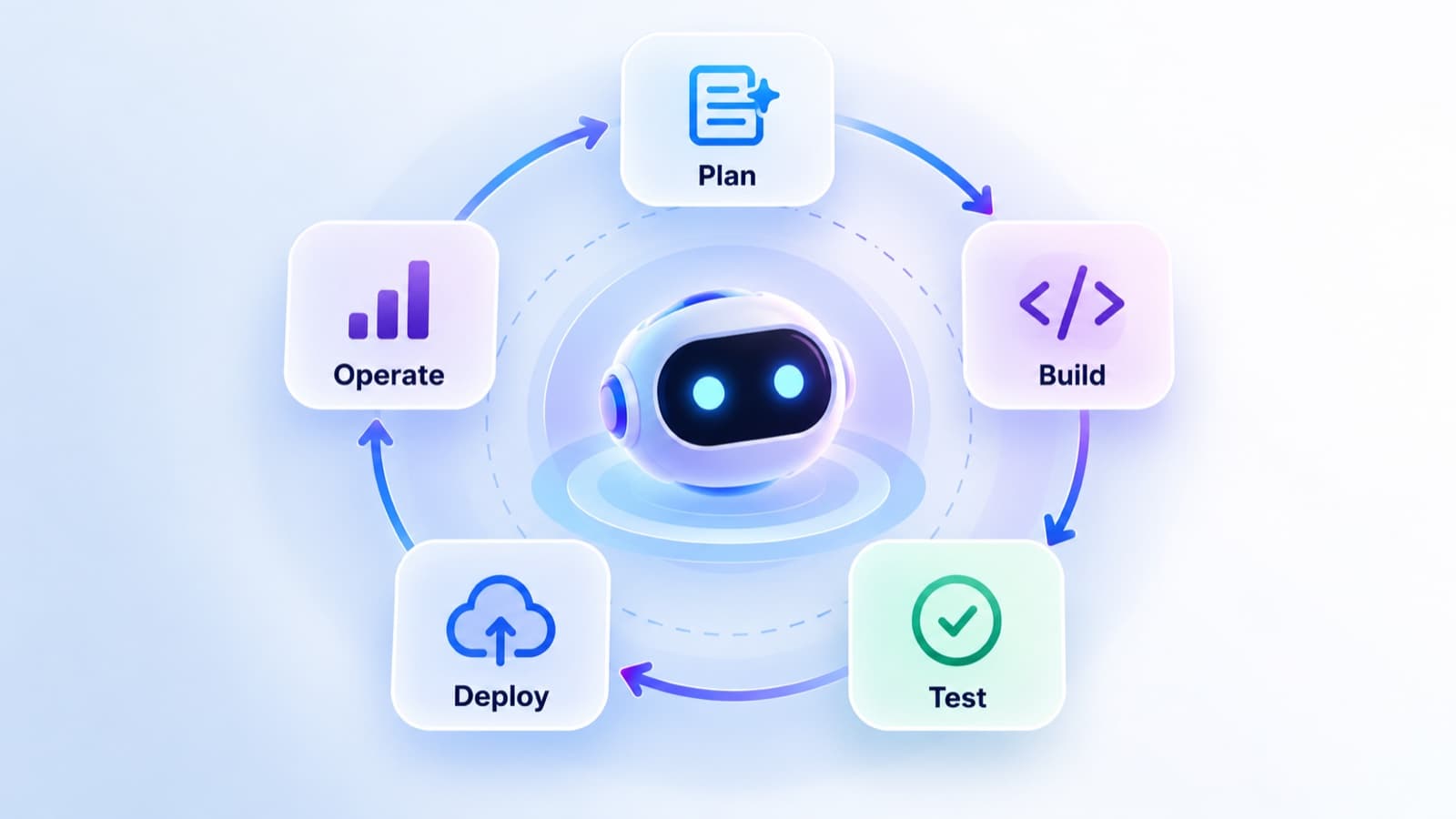
The G.U.I.D.E. method is a five-phase approach to governing AI-assisted software delivery: Goals and Guardrails, Understand, Integrate, Deliver, Evaluate. Every phase ends with a person approving what happens next.
Where G.U.I.D.E. sits
An AI-native SDLC playbook: a governed method in which AI amplifies human judgement.
Vibe coding
Unreliable, unstructured, no governance.
G.U.I.D.E.
Governed. Production-grade.
The structured middle ground for real enterprise AI development.
AI fragmented
Narrow tool adoption, no SDLC integration.
What it is
G.U.I.D.E. is a harness for AI coding agents: the rules, templates and checks wrapped around the agent, so that it works the way your team does and every decision is recorded. It works with all the popular coding agents, including Claude Code, Cursor, Kiro, Google Antigravity, Windsurf and OpenAI Codex.
It works at two levels.
The engagement
Moves through five phases, from agreeing the goals to measuring the result, and a person signs off each one.
The five phasesEvery change
Runs through the Tight Loop: AI Plans, Seeks Human Guidance, AI Implements, Human Clarifies. A typo fix moves fast; a change to a payment flow gets full requirements and design first.
The Tight LoopEvery prompt and every decision is logged with a timestamp, so an auditor can see who agreed to what, and when.
See it run:

A good harness should not necessarily aim to fully eliminate human input, but to direct it to where our input is most important.
martinfowler.com, February 2026
The five phases
Each phase ends at a gate: nothing moves on until the named person signs it off.
- G
Phase 1
Goals and Guardrails
- What happens
- Agree the target outcome, the success metric and the baseline, and define what AI may and may not touch.
- Who is involved
- Your sponsor, your technical lead and our engagement lead.
- Deliverables
- A one-page charter with baseline figures and guardrails
Sign-off: Your sponsor signs the charter.
- U
Phase 2
Understand
- What happens
- Reverse-engineer the codebase or process, map systems, dependencies and risks, and rank candidate use cases.
- Who is involved
- Our engineers, working with your team.
- Deliverables
- System map
- Risk register
- Ranked list of use cases
Sign-off: Your technical lead confirms the system map is accurate.
- I
Phase 3
Integrate
- What happens
- Set up the harness in your repositories and pipelines, configure role-specific workflows, and run the first change through the loop.
- Who is involved
- Our engineers and your developers.
- Deliverables
- Configured harness, with rules and prompts
- The first merged change
Sign-off: The first change passes your code review and your CI pipeline.
- D
Phase 4
Deliver
- What happens
- Ship backlog items through the governed loop, with tests, documentation and reviews generated and checked.
- Who is involved
- Your team, with ours alongside.
- Deliverables
- Merged features
- Test suites
- Requirement and decision records
Sign-off: A person approves every change, and releases follow your process.
- E
Phase 5
Evaluate
- What happens
- Re-measure against the baseline using DORA, SPACE and DevEx, the industry-standard measures of delivery speed, quality and developer experience, then decide whether to scale, continue or stop.
- Who is involved
- Your sponsor, your technical lead and our engagement lead.
- Deliverables
- Impact report
Sign-off: Your sponsor reviews the impact report, which opens the next cycle or the handover.
The Tight Loop
Selective Intelligence
Executes only value-adding steps per request. No unnecessary automation — every AI action is deliberate and purposeful.
Code-Aware
Analyzes existing codebase, architecture patterns, and required complexity before proposing changes. Context-first, not prompt-first.
Risk-Aware
Deep handling for high-risk operations, fast handling for low-risk ones. The framework adjusts its governance depth based on blast radius.
Controlled Execution
Each phase runs only after human review and approval. No autonomous code merges, no unreviewed deployments. Humans stay in the loop.
See it on your codebase.
A 30-minute call to map the method to your current workflow and pick the first change to run through it.