

















Interactive blog New Delhi 13–15 October 2026
The Bloomberg New Economy Forum: What It Means for India
India’s leaders and business voices weighed in on jobs, money, education, trade and AI. Here are the key takeaways, in their own words, and why they matter to you.
Begin
The opening addressDay one
Prime Minister Narendra Modi
“Power to Empower”
“The real question is not who possesses power. Rather, the question is how that power is being used.”
Technology, data, knowledge and innovation are all forms of power, he said, and India’s test is whether they reach everyone: one digital payments system for the street vendor and the car showroom, government help paid straight into bank accounts.
Quotes from the official English text. Watch 03:19 Watch 10:21
More from the forum
“Supply chains, energy, minerals, payment systems, and technology are increasingly becoming instruments of pressure and dominance.” Watch 21:55
The same morning, Nandan Nilekani, Co-founder and Chairman of Infosys, argued the opposite for AI: “I don’t see how anybody can create a choke point here.” Watch 04:08















1 of 5Money
Imports and loans will cost more for a while.

“They are not trying to fix the rupee. They are trying to stop the volatility.”
Nirmala Sitharaman called the rupee’s fall over the past year and a half “very significant”, mostly because of “challenges outside”. On taxes for investors she promised nothing before the budget: “I will tread cautiously on that.”
How a closed strait reaches your EMI
“We see that clearly in the war in Iran, the Strait of Hormuz closed”
Tom Orlik, Chief Economist, Bloomberg Economics Watch 01:30
“oil prices are shooting through the roof. Supply chains are broken.”
Sunil Bharti Mittal, Founder and Chairman, Bharti Enterprises Watch 00:21
“the rupee has depreciated and principally on account of supply chain disruption and oil prices.”
Sunil Bharti Mittal, Founder and Chairman, Bharti Enterprises Watch 05:13
“a significant blow to global energy supplies, oil prices up, inflation up”
Tom Orlik, Chief Economist, Bloomberg Economics Watch 01:53
“the Federal Reserve, European Central Bank and reserve Bank of India forced to hike interest rates.”
Tom Orlik, Chief Economist, Bloomberg Economics Watch 01:53
Our reading, not a speaker’s: higher policy rates usually feed through to floating-rate home and car loans.
“We see that clearly in the war in Iran, the Strait of Hormuz closed”
Tom Orlik, Chief Economist, Bloomberg Economics Watch 01:30
More from the forum
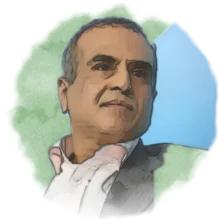
“the rupee has depreciated and principally on account of supply chain disruption and oil prices.” He called it temporary.
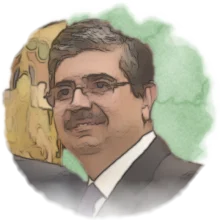
“what mattered in the world was not more than ten stocks, and therefore all the money went in there.” He would let the rupee find its own level.
On the capital gains change two years ago: “I wasn’t increasing the tax. I was bringing all of them to be at par with one another”



2 of 5Jobs
AI will change jobs more than it ends them.
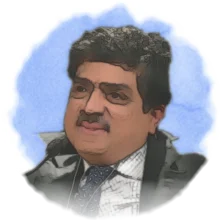
“the transformation of enterprise is a very complex activity… it’s a root and branch surgery that is required.”
Asked whether fears that AI will wipe out IT jobs were “hogwash”, he said “Absolutely”, calling them “disaster marketing”. His reason: companies take years to change, so there is more work, not less. Salil Parekh, Chief Executive of Infosys, agreed on stage: “I think Nandan is right.” Watch 28:41
More from the forum
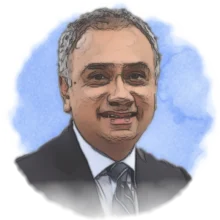
AI work is already “about 8% of our revenue, but growing double digit quarter on quarter.” Infosys plans to hire “another 20,000 college graduates.”
The other side, raised in the room: shares of Infosys, TCS and others are “all down 33% this year”, said the interviewer. Nandan Nilekani left that to the markets. Watch 07:56
Bars to scale; Aadhaar drawn at 7.5 years. “Technology diffusion, penetration takes time. We deal with human beings.”
2 of 5Jobs: where the work moves
Coding is automating. The other 70% is where the jobs are.
About 30%.
Nandan Nilekani: “70% is governance, change management, transformation, guardrails.” Watch 08:53
 Abhijit Dubey, President and Chief Executive of NTT DATA, put it in money: of every $10 spent on AI, the model is $1. Watch 24:30
More from the forum
Abhijit Dubey added a caution: “only like 20% of the clients that we work with truly get the value” from AI so far. Watch 24:30





 Technology, 30%The work around it, 70%
2 of 5Jobs: the next five years
Services work faces a rough few years. India is preparing.
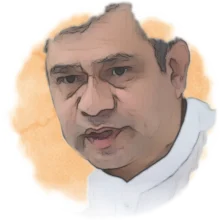
“The turbulence is going to be much more than what it was in the past decades.”
He expects two shocks to meet, perhaps in “three years, four years, five years, I don’t know”: debt trouble in rich countries, and AI changing how people work, “especially the services industries”. Watch 26:36 India’s cushion, he said, is public debt cut “from 61% to 55% over the last five years.”
What it means for you Our reading
If you work in IT or services. Expect the routine parts of the job to change first: drafting, testing, first-line support and reporting. The work Nandan Nilekani counted in his 70%, understanding the business, managing change and checking what AI produces, is where people stay in demand.
If you are studying. Infosys still plans to hire “another 20,000 college graduates”, its chief executive said. Learn to use AI on real tasks, and learn the field it serves; knowing the field is the harder part to automate.
If you run a business. Use the next two or three years to plan: which tasks will change, who you will retrain, and what you will measure to know that it worked.
“maybe in three years, four years, five years, I don’t know.” Years counted from October 2026.
India’s cushion: public debt to GDP
3 of 5Exams
A fix for exam leaks is on its way.
“have a massive bank of questions and only at the last minute generate the question paper for that day and therefore… there’s no economic incentive for that.”
He chairs the Prime Minister’s task force on exam reform, set up after the NEET leak. A fixed paper is worth stealing; a paper that does not exist until the morning is not. He also wants every exam on computer, with more than today’s 1.5 lakh test centres. His report was commissioned on 28 July with three months to run, which puts it around the end of October. Watch 15:30

Illustration of the idea, not real questions.
4 of 5Trade
New trade deals open markets; the US deal is still open.
India’s trade agreements now cover “$70 trillion of GDP”, said Piyush Goyal, Union Minister of Commerce and Industry, and the deal with the EU, 25 years in the making, could take effect early next year. On the US, three people at the forum read it three ways.
“So it’s a very safe relationship.” The US is India’s largest trading partner, he said, and will stay so.
Piyush Goyal, Union Minister of Commerce and Industry Watch 36:54
“we’re we’re kind of almost there.” A deal has two halves, he said: the terms with the US, and how India fares against rivals who have not settled yet.
Dr Subrahmanyam Jaishankar, Union Minister of External Affairs Watch 08:55
“The US is a question mark.” More than $100 billion of Indian exports face higher tariffs.
Sunil Bharti Mittal, Founder and Chairman, Bharti Enterprises Watch 06:50
More from the forum

On the EU deal: “it actually opens up an enormous market, a very mature market with a great purchasing power.” Earlier deals underdelivered, he said, because partners competed with India rather than complemented it.

On the US deal: “I’m confident we will have a trade deal here … We’re very close to landing it.” The big items are done, he said; what is left is detail across “tens of thousands of points”.

“from $10 trillion of GDP, which was open to India to preferential market basis until 2014. Today, as we speak, we have trade agreements covering $70 trillion of GDP.”





5 of 5AI rules
AI rules are coming, and should come before an accident.
“I think there’s a pretty good consensus on this that, yes, there should be, uh, regulation, there should be guardrails.”
Nuclear technology had a few users, he said; AI is like electricity, “the mother of all technologies”, and it will touch everyone, including elections. Watch 26:14 Sunil Bharti Mittal wants the rules before an accident: “Are we going to wake up only when an accident happens and we do it before?” Watch 13:18
Turn the dial: the more an AI agent is allowed to do, the more safeguards it needs. The safeguards are our checklist.
Acts with approval
Sends it after a person clicks approve.
- A clear task and an owner
- A test set it must pass
- A person approves each action
- Every action logged
- Written limits, a way to undo, a way to stop
- Spending caps, with a second approver above them
- A weekly review of a sample of its work
Five things to take from Delhi
- Imports and loans will cost more for a while.
- AI will change jobs more than it ends them.
- A fix for exam leaks is on its way.
- New trade deals open markets; the US deal is still open.
- AI rules are coming, and should come before an accident.


सङ्गच्छध्वं संवदध्वं सं वो मनांसि जानताम्
“Let us walk together. Let us speak together.” The Vedic line the Prime Minister closed with.
Our viewDeployProAI
Where we stand
We build AI systems for companies, and train the people who use AI in companies and colleges. Four of the forum’s arguments meet our own work.
- On guardrails
Dr Subrahmanyam Jaishankar sees a consensus that AI needs guardrails; Sunil Bharti Mittal wants them in place before an accident, not after.
Guardrails belong inside each AI system, not only in law.
How we help. We build AI agents for customer conversations, email and back-office work with a person approving each action, every action logged and a way to stop it, and we govern delivery the same way.
The G.U.I.D.E. method: human approval at every stage - On the 70%
Nandan Nilekani put technology at about 30% of the work; Abhijit Dubey said only about one in five of NTT DATA’s clients truly gets the value so far.
The model is the easy part. The 70% around it decides whether AI pays.
How we help. We deploy AI agents into the process itself, with its data, hand-offs and human escalation, and measure the result against your own baseline.
Agentic AI, deployed into your processes - On jobs and skills
Ashwini Vaishnaw expects turbulence for services work within five years; Salil Parekh said Infosys still plans to hire another 20,000 college graduates.
Colleges can send graduates out ready for that change, able to build with AI.
How we help. With colleges, we run on-campus programmes in which every level ends with a product students deploy, and a faculty programme in which each teacher builds working material for their own course.
AI programmes for universities, aligned with NEP 2020 and AICTE - On spending
Abhijit Dubey’s rule for every $10 spent on AI: $1 on the model, the other $9 on building the agent and managing change, on guardrails and security, and on data.
Know where you stand before you spend the other $9.
How we help. Our AI Readiness Assessment looks at your code, data, team and delivery process over three to six weeks, and ends in a prioritised roadmap with measurable targets and a costed plan.
AI Readiness Assessment
Read nextFrom our blog
Go deeper on what the forum raised
 The 70%Why AI Fails in ProductionAI now writes half the code in many engineering teams, yet most enterprise pilots show no measurable profit. What the 2025 and 2026 evidence says, why the gains stall before production, and how the teams that get results work.
 Agents and guardrailsAgentic AI vs Generative AI: What Engineering Leaders Need to KnowGenerative AI drafts; agentic AI acts. Here's how the two differ, where each fits, and what agentic systems demand of your 2026 SDLC strategy.
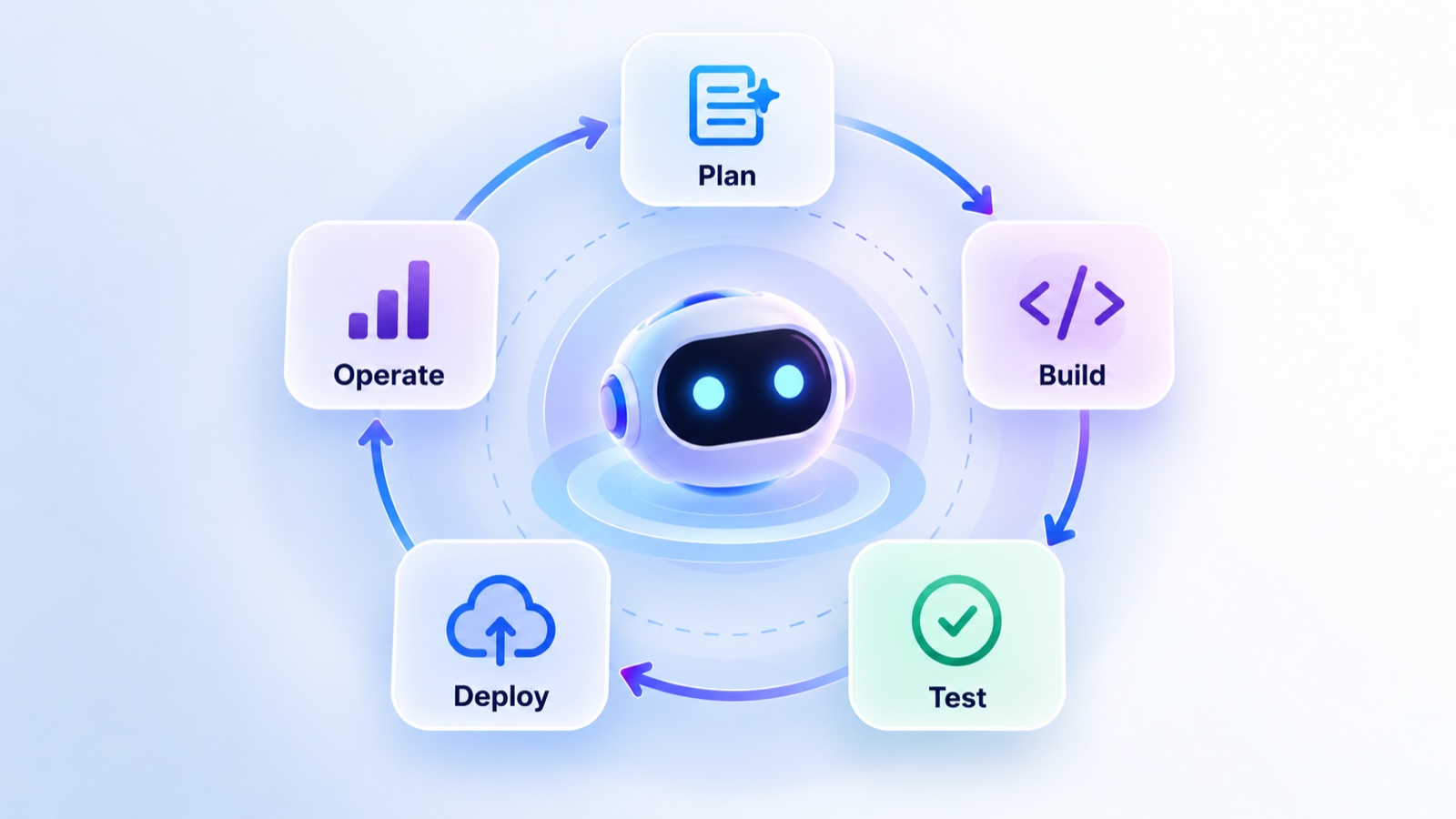 Services workWhat Is an AI-Native SDLC? A 2026 PlaybookAn AI-native SDLC brings AI into every phase of delivery under governance. Here's why coding assistants alone stall, and what actually changes delivery.
 Trust and auditVoice AI in Regulated Enterprises: 5 LessonsThe hardest part of enterprise voice AI is trust: accurate facts, never dead air, full audit trail. Five lessons from building a production insurance voice bot.