When someone asks an AI assistant which firm to hire, which hospital to visit or which product to buy, the answer often arrives as a short paragraph with a handful of names in it. Answer engine optimisation (AEO) is the work of making sure your business is one of those names, and that what the assistant says about you is correct. This post explains how AEO relates to SEO, what the evidence says, and the practical steps that work.
Key Takeaways
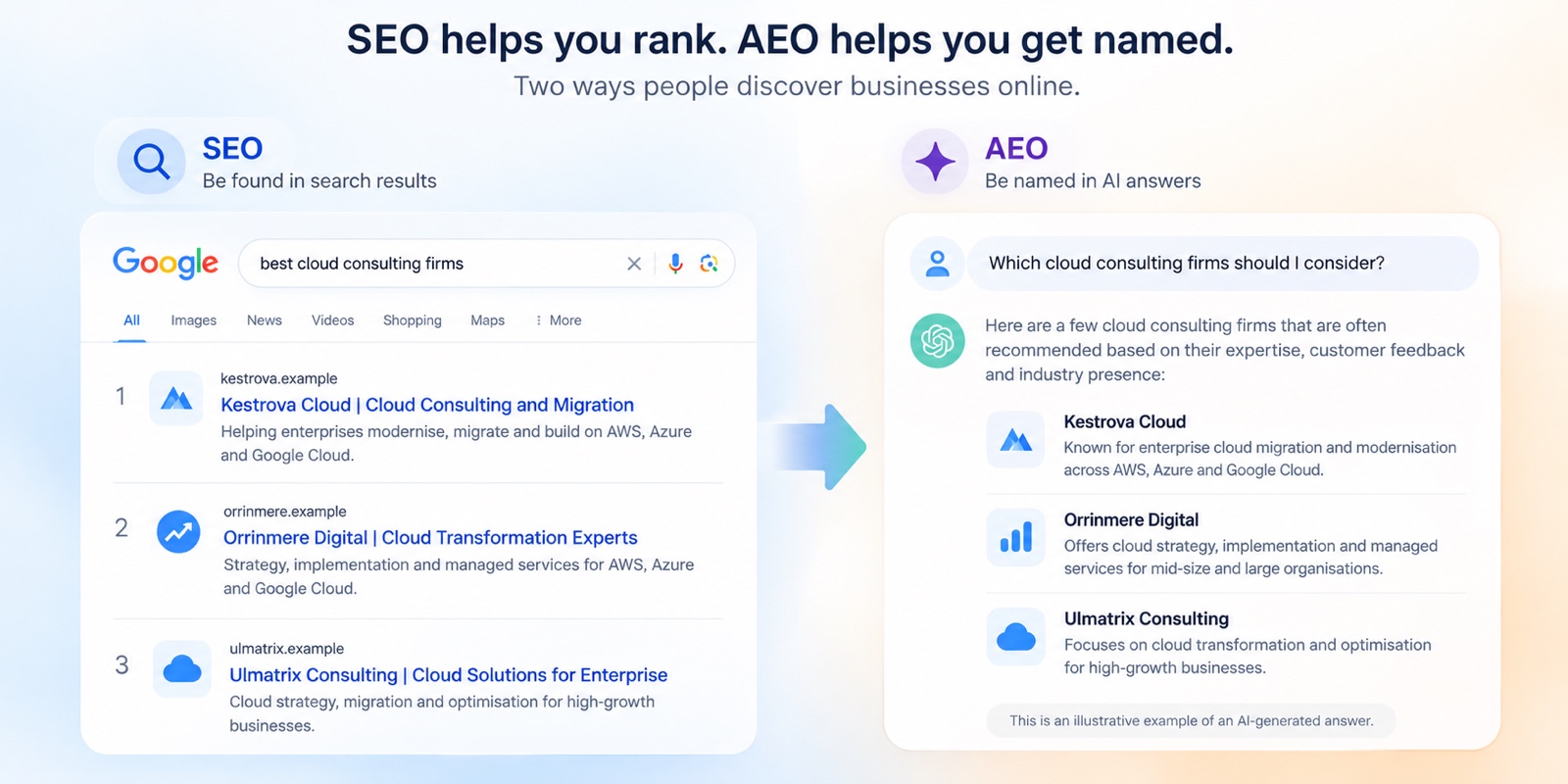
- AEO aims for inclusion and citation in AI-generated answers; SEO aims for a high position in search results. The two share most of their foundations.
- When Google shows an AI summary, people click a traditional result on 8% of visits, down from 15% without one (Pew Research Center, 2025).
- AI answers favour content that answers a question directly, stays consistent across the web, and carries verifiable evidence.
- Measure AEO by re-asking the same set of buyer questions over time and tracking how often, and how accurately, AI names you.
What is answer engine optimisation?
Answer engine optimisation is the practice of making your business easy for AI systems to find, understand and cite. The answer engines are ChatGPT, Gemini, Claude, Perplexity, and the AI features inside Google Search, such as AI Overviews and AI Mode.
Researchers use a related term, generative engine optimisation (GEO). It was introduced in a 2023 paper from Princeton University and IIT Delhi, presented at KDD 2024, which showed that changes to how content is written can raise its visibility in generative engine responses by up to 40% (Aggarwal et al., 2024). AEO and GEO describe the same goal. This post uses AEO.
How is AEO different from SEO?
SEO and AEO answer different questions about the same content.
| SEO | AEO | |
|---|---|---|
| Goal | A high position in search results | Inclusion and citation in AI answers |
| Where it shows | Lists of links on search pages | Paragraph answers in AI assistants and AI Overviews |
| What the user does | Scans results and clicks through | Reads the answer, often without clicking |
| Main signal | Relevance and authority of a page | Clarity, consistency and evidence across many sources |
| How it is measured | Rankings, clicks and organic traffic | How often AI names you, how accurately, and against whom |
The overlap is large. Google's guidance for site owners says the best practices for SEO remain relevant for AI features in Google Search, and that no additional steps are needed to appear in them (Google Search Central). AEO builds on SEO: a site that search engines cannot read is one that AI systems cannot read either.
Why does AEO matter now?
People increasingly take the answer and leave. In a study of 900 US adults' browsing in March 2025, Pew Research Center found that users clicked a traditional search result on 8% of visits to pages with an AI summary, against 15% on pages without one. They clicked a link inside the summary itself on only 1% of visits, and 26% of visits to pages with a summary ended the browsing session there, against 16% without (Pew Research Center, 2025).
For a business, this changes what visibility means. If a buyer forms a shortlist from an AI answer and never visits your website, the AI's description of you is your first impression. Wrong pricing, an outdated service list or an unsupported claim repeated by an AI system costs you the enquiry before you know it existed.
How do you optimise for AI answers?
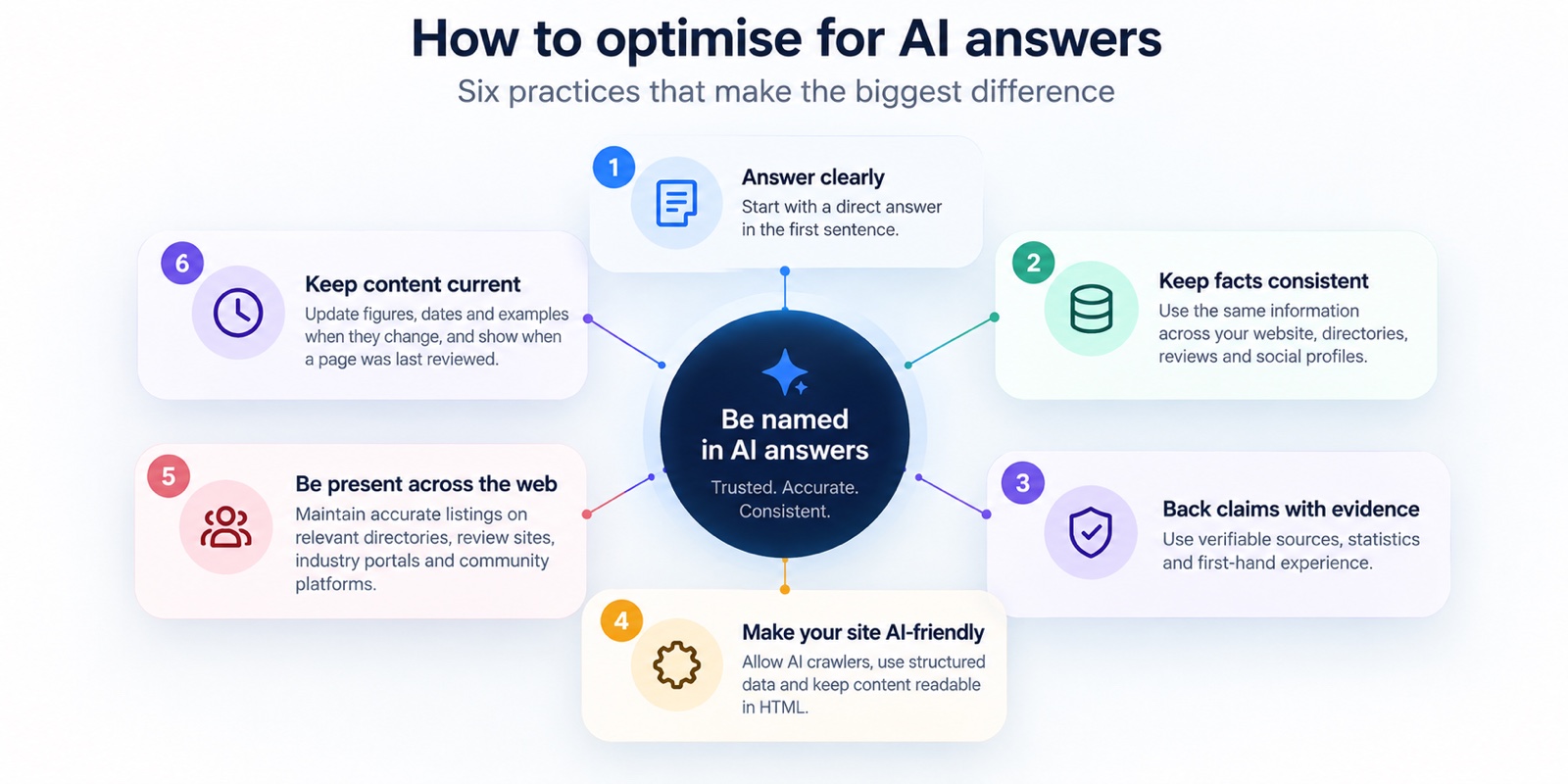
Six practices make the biggest difference. Most of them also improve SEO.
1. Answer the question in the first sentence
Start each section with a direct sentence that answers the question in its heading, then add detail. Keep each section self-contained, so that it still makes sense when an AI system lifts it out of the page. Headings phrased as the questions buyers actually ask help both people and machines find the answer.
2. Keep your facts consistent everywhere
AI systems cross-check what they read. When your website, directory listings, review sites and social profiles disagree about your services, prices, credentials or locations, the answer becomes vague or wrong. Use one name for each product and service, publish one source of truth for key facts, and correct contradictions on third-party sites.
3. Back claims with evidence others can verify
In the GEO research, adding citations, quotations and statistics to content were among the methods that most improved visibility in generative answers (Aggarwal et al., 2024). Dated results, named sources and first-hand experience give an AI system something it can repeat with confidence. Remove or substantiate claims such as "No. 1" or "assured results" that nothing on the web supports.
4. Make your site readable to AI crawlers
Check that your robots.txt and firewall do not block the crawlers that AI services use. Put key content in the page's HTML, where it is visible without running scripts. Publish structured data (schema.org markup for your organisation, services and frequently asked questions) and keep your sitemap's last-updated dates accurate.
5. Be present where AI systems read
AI answers draw on more than your own website: sector portals, directories, comparison and review sites, Wikipedia, YouTube and community forums. Accurate, current listings on the sources that matter in your sector are part of AEO, and they are often where the largest gaps sit.
6. Keep content current
Update figures, dates and examples when they change, and say when a page was last reviewed. Freshness helps only when the content itself is new: changing a date without changing the substance adds nothing.
How do you measure AEO?
Measure what AI systems actually say. A practical method has three parts:
- Fix a question set. Choose 20 or so real buyer questions, phrased the way a prospect would ask them, that do not name you or a competitor. Any mention you earn is then genuine.
- Ask every engine. Put the same questions to ChatGPT, Gemini, Claude and Perplexity, and record whether you are named, where, in what terms, and which competitors appear instead.
- Repeat on a schedule. AI answers vary between runs, so treat each audit as a dated reading. Re-asking the same questions monthly or quarterly makes progress comparable over time.
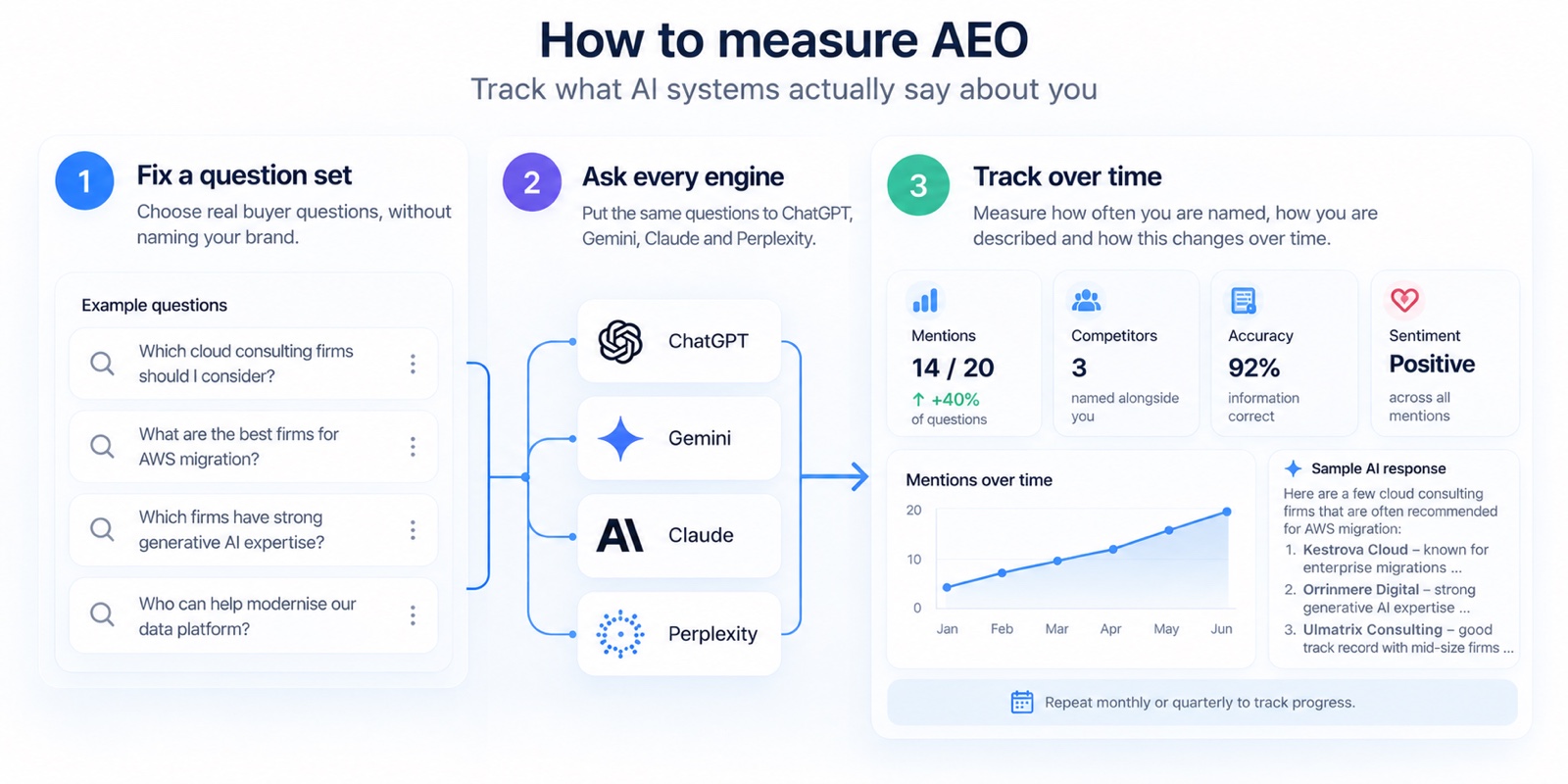
Alongside traditional rankings and traffic, the measures that matter are brand visibility, share of voice against competitors, sentiment, the sources AI cites when it describes you, and the accuracy of what it says about your services, pricing and results.
Where should you start?
Start by finding out what AI says about you today. Run your buyer questions across the main engines, note where you are missing and where you are described wrongly, and rank the fixes by what blocks what. Technical fixes on your own site are usually quickest; accuracy on third-party sources takes longer and matters as much.
At DeployProAI we run this as an AI Answer Visibility Assessment: a structured audit across four AI engines, a gap report with a prioritised action plan, and guided remediation with your teams. We do not guarantee placement in AI answers; we measure, fix and track.
Sources
| Source | Used for | Date |
|---|---|---|
| Pew Research Center, Google users are less likely to click on links when an AI summary appears | 8% vs 15% clicks, 1% clicks in summaries, 26% vs 16% session ends | July 2025 |
| Aggarwal et al., GEO: Generative Engine Optimization (KDD 2024) | Up to 40% higher visibility; citations, quotations and statistics | 2024 |
| Google Search Central, AI features and your website | SEO best practices apply to AI Overviews and AI Mode | 2025 |
Frequently asked questions
What is answer engine optimisation (AEO)?
Answer engine optimisation is the work of making your business easy for AI systems such as ChatGPT, Gemini, Claude, Perplexity and Google's AI Overviews to find, understand and cite, so that they name you, and describe you accurately, when someone asks a question you can answer.
What is the difference between AEO, GEO and SEO?
SEO aims for a high position in search results. AEO aims for inclusion and citation in AI-generated answers. GEO, generative engine optimisation, is the term used in research for the same goal across generative engines. In practice, AEO and GEO build on SEO, because AI systems read the same web that search engines index.
Is traditional SEO dead?
No. Google's own guidance says the best practices for SEO remain relevant for its AI features, and that no extra steps are needed to appear in them. AEO adds to that foundation: answer-first writing, consistent facts across the web, and measurement of what AI actually says about you.
How long does AEO take to show results?
Technical fixes, such as letting AI crawlers read your site and publishing clear structured data, can be picked up within weeks. Changes that depend on other websites, such as directory listings, reviews and reputation, take longer. Because AI answers vary between runs, progress is best measured by re-asking the same set of questions at regular intervals.
Can one page be optimised for both SEO and AEO?
Yes. A page that answers a real question directly, keeps each section self-contained, uses consistent names for your business and products, and carries evidence that others can verify serves both search rankings and AI answers.
Related on DeployProAI
About the author

Ashish Tripathi is the founder of DeployProAI. He has spent more than twenty years building enterprise-scale systems, from wealth platforms at Morgan Stanley to technology strategy for a $300M+ ARR portfolio at Amazon Web Services. He is 4X AWS certified, and has mentored more than 200 engineers across 100+ enterprises and software companies. Before founding DeployProAI he delivered AI-native software development cohorts for AWS enterprise customers, including Deloitte, Axis Bank, HDFC Bank and Care Health Insurance.